
Criminal Cases in the Clarendon County Courts
Clarendon County criminal court cases do not all reach the same counter. The South Carolina Circuit Court, sitting as the Court of General Sessions in the Third Judicial Circuit, hears felonies and more serious criminal matters. Magistrate courts conduct bond hearings and hear cases within their statutory authority. Manning, Summerton, and Turbeville municipal courts keep ordinance, traffic, and qualifying lower-level criminal cases that arise within their towns. The court named on the citation, warrant, or docket controls where the official file lives.
The Clarendon County Clerk of Court maintains General Sessions files at 102 South Mill Street in Manning. Those files may contain the indictment, motions, hearing entries, plea, verdict, disposition, and sentence. The Third Circuit Solicitor prosecutes General Sessions cases, but the clerk is the record custodian. Start there when the goal is an official court copy. The sheriff or detention center can describe an arrest or booking, yet neither replaces the filed Clarendon County criminal case record.
Clarendon County Criminal Case Counter
The Judicial Branch courthouse profile identifies the Clarendon County courthouse and its court links. The clerk can help locate a current General Sessions file when Public Index shows a docket entry but no document image. Use the full case number if available. For a name request, add a filing range and the charge or court type so staff can distinguish similar names.
The official courthouse source supplied this view of the Clarendon County criminal case destination.
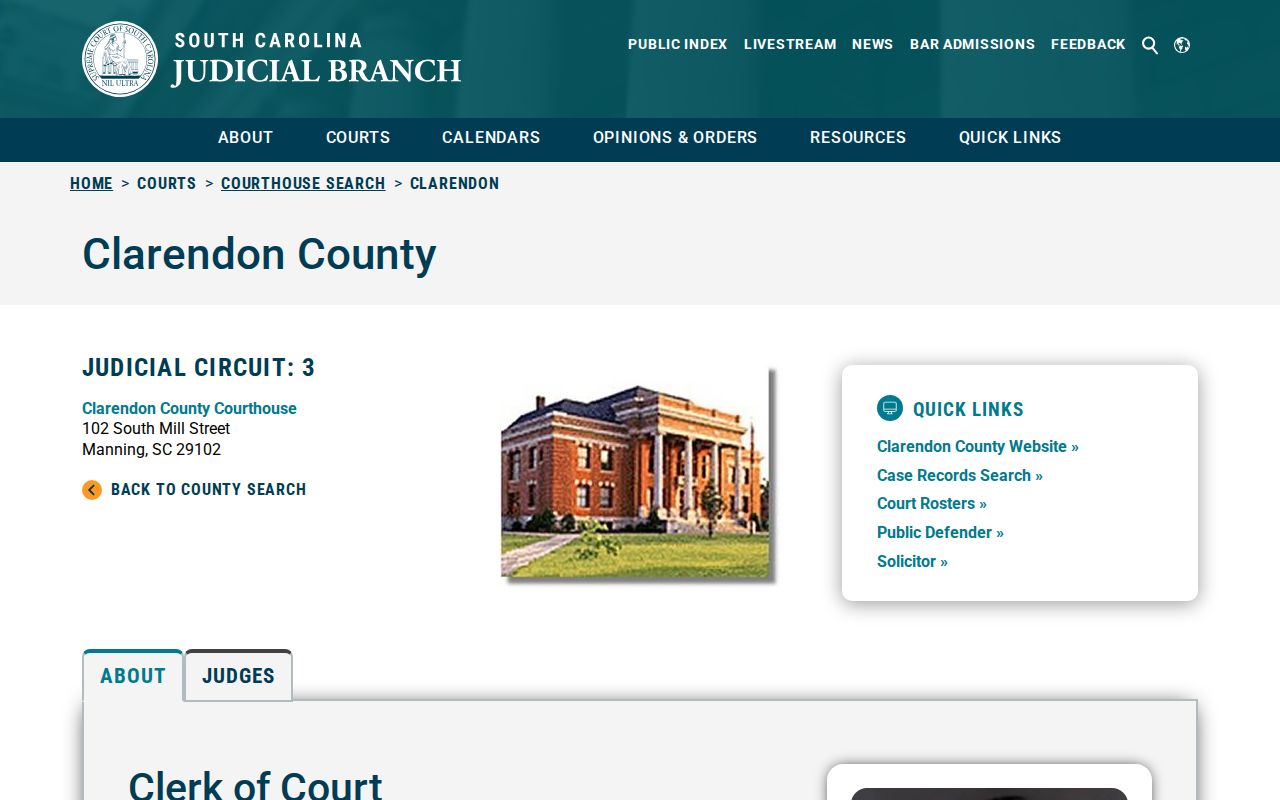
The image reinforces why the clerk, rather than the jail, is the place to request a sentencing sheet or certified disposition. Call 803-435-4443 before mailing payment or making a trip. Current copy, certification, counter hours, security rules, and parking details were not confirmed in the official material, so verify each point first.
How to Search Case Records
The free South Carolina Judicial Branch Case Records Search routes readers to Clarendon County Public Index. It works best with cookies and JavaScript enabled, and a browser may need permission to open case-detail pop-ups. Search by party name when the case number is unknown. An exact case number is the cleaner route. Check the court and county on the result before treating a same-name entry as the intended person.
- Open Case Records Search and select Clarendon County from the statewide route.
- Search by party name, or enter the full case number when it is known.
- Narrow broad results by filing date, court, case type, or status when those controls appear.
- Open the case detail and read each count, event, and disposition separately.
- Ask the correct clerk for a missing filing, sentencing sheet, or certified disposition.
| Field or control | Type | Required | Use |
|---|---|---|---|
| County, City, or ZIP | Search text | Yes at router | Select Clarendon |
| Party name | Text | One route | Use when case number is unknown |
| Case number | Text | Alternative | Best exact-case key |
| Court or case type | Filter | No | Choose General Sessions when shown |
| Date range | Date filter | No | Narrows common names |
| Case-detail pop-up | Link | No | May require a browser exception |
After opening a result, compare the filing date, venue, and charge before reading the event list. A docket event can record a scheduled hearing or filed paper without deciding the case. If the pop-up remains blocked, note the case number from the results screen and use it when contacting the Clarendon County clerk.
Clarendon Criminal Case Address Change
A blank home-address field is not a broken Clarendon County criminal case search. The Judicial Branch stopped displaying home addresses for both new and existing Public Index cases on January 1, 2026. Core docket data can still appear, but readers should match a case by court, case number, filing date, charge, and disposition rather than expect a street address. That privacy change also reduces the value of using address alone to separate people with similar names.
Public Index is an index, not a promise that every filed document is downloadable. If the entry lacks the pleading or order needed, note its docket description and date before calling the clerk. Ask for that item, not an undefined “full background.” This keeps the Clarendon County court request tied to a known public case and avoids needless search work.
Note: Public Index address suppression applies to display, while the clerk still controls access to the underlying court record under law.
What the Case File Shows
A Clarendon County criminal case file is organized around one prosecution. Its docket can link charges to an indictment or other charging paper, hearings, motions, counsel entries, plea or trial, disposition, and sentence. Counts in the same case may end in different ways. “Pending” is not a finding of guilt. A dismissal, acquittal, or nolle prosequi ends that charge without a conviction, though it does not by itself prove that every arrest record has been removed.
| Case number and court | Identifies the venue, county, and individual court matter. |
|---|---|
| Charging document | Shows the accusation filed through a warrant, indictment, or other allowed paper. |
| Docket entries | List filings, motions, notices, hearings, pleas, trial events, and orders. |
| Parties and counsel | Name the prosecution, defendant, and attorneys entered in the case. |
| Disposition | Records the outcome of each charge, such as pending, guilty, dismissed, nolle prosequi, or acquitted. |
| Sentence | May state confinement, a suspended term, probation, and financial obligations. |
Home addresses are no longer shown in Public Index. Protected victim or minor data, Social Security numbers, sealed matters, and juvenile records may also be absent or restricted. When the exact outcome matters, obtain the sentencing sheet or a certified disposition from the clerk instead of relying on a short status label.
Clarendon County Municipal Case Stops
The official municipal court directory confirms three distinct lower-court contacts in Clarendon County. Manning Municipal Court is at 36 West Boyce Street and answers at 803-433-0050. Summerton Municipal Court uses its courtroom at 10 Main Street and 803-485-2525. Turbeville Municipal Court is at 1400 Main Street and 843-659-2781.
The municipal directory is also the source for this Clarendon County criminal court image.
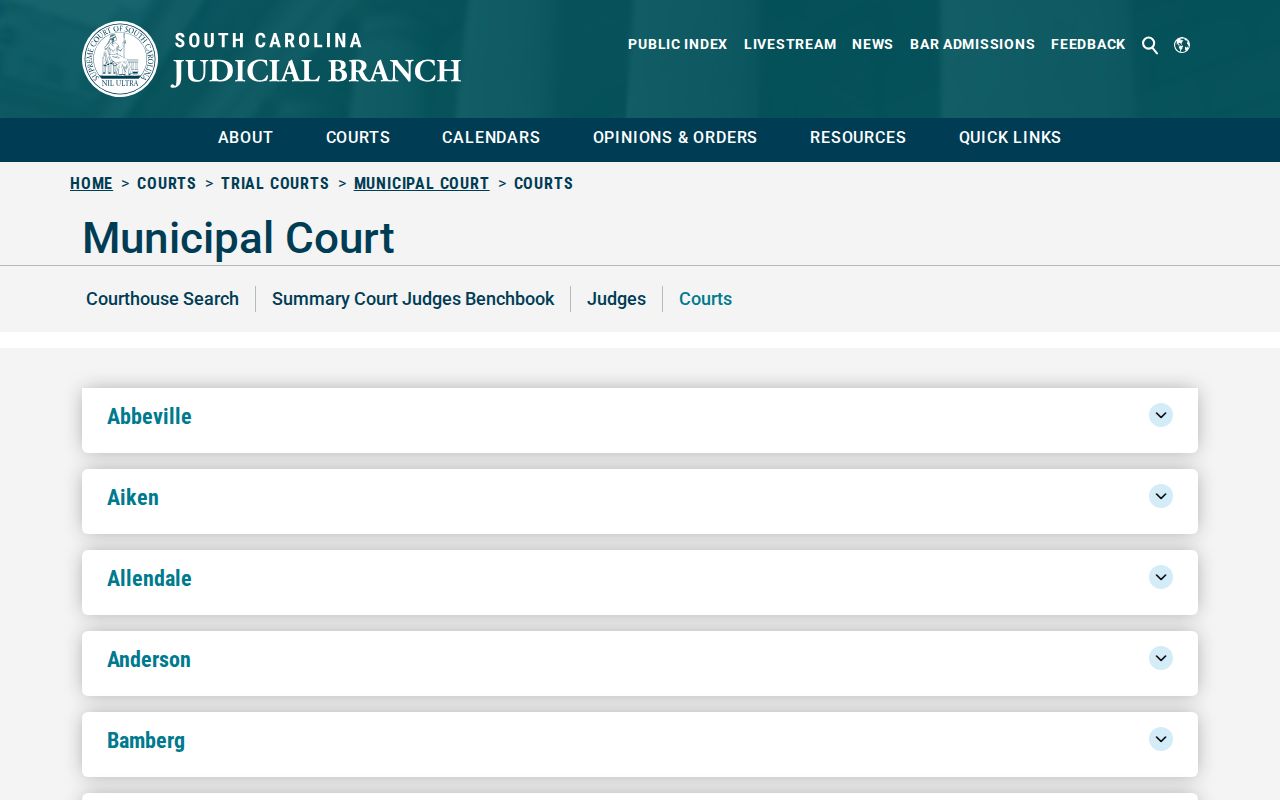
The image marks the key split in local access. The Judicial Branch states that only some municipal records appear online. If a Manning, Summerton, or Turbeville matter is missing, call that court with the name, citation, warrant or case number, and approximate date. A municipal file does not move to the General Sessions clerk merely because the searcher lives elsewhere in Clarendon County.
Stages of a Criminal Case
A serious Clarendon County criminal case may begin with a complaint or warrant, then pass through a bond proceeding and preliminary steps before a grand jury considers an indictment. Arraignment addresses the formal charge and plea. Motions and hearings shape what evidence or issues reach trial. Many cases end in a negotiated plea, while others proceed to trial. The court then records the result and, after a conviction, imposes sentence.
Case flow: Charges Filed › Arraignment › Pretrial › Plea or Trial › Disposition › Sentencing
An arrest charge can change before indictment. That is why the filed charge and final disposition deserve more weight than the booking label. A Clarendon County case with several counts must be read count by count. One count may be dismissed while another produces a plea and sentence. Post-trial motions and an appeal can add later entries without erasing the lower-court docket.
Clarendon Criminal Case Docket Terms
South Carolina court words can compress an important result into one line. The following terms help decode a Clarendon County criminal case without treating each docket event as a final outcome.
- Arraignment
- The hearing where the charge is formally presented and a plea is addressed.
- Indictment
- A grand-jury accusation that authorizes prosecution in General Sessions.
- Nolle prosequi
- The prosecutor’s formal choice not to continue a charge at that time.
- Disposition
- The recorded outcome of a charge or case.
- Acquittal
- A not-guilty determination after the case is decided.
- Concurrent sentence
- A sentence served at the same time as another sentence.
A plea agreement is a proposed negotiated result that still requires court action. A conviction follows a guilty plea or verdict; a dismissal does not. For a full court-to-repository comparison, the Clarendon County arrest history page explains why the booking charge, filed charge, and final court result can differ.
Historic Clarendon Criminal Case Journals
Modern Clarendon County criminal court cases belong in Public Index or at the current clerk’s counter. Older research follows another trail. The South Carolina Archives county-record guide describes historical General Sessions criminal journals and related Clarendon County record series. These sources can support genealogy, institutional history, or research on a case that predates the online index.
The State Archives guide supplied this view of the older Clarendon County criminal case record path.
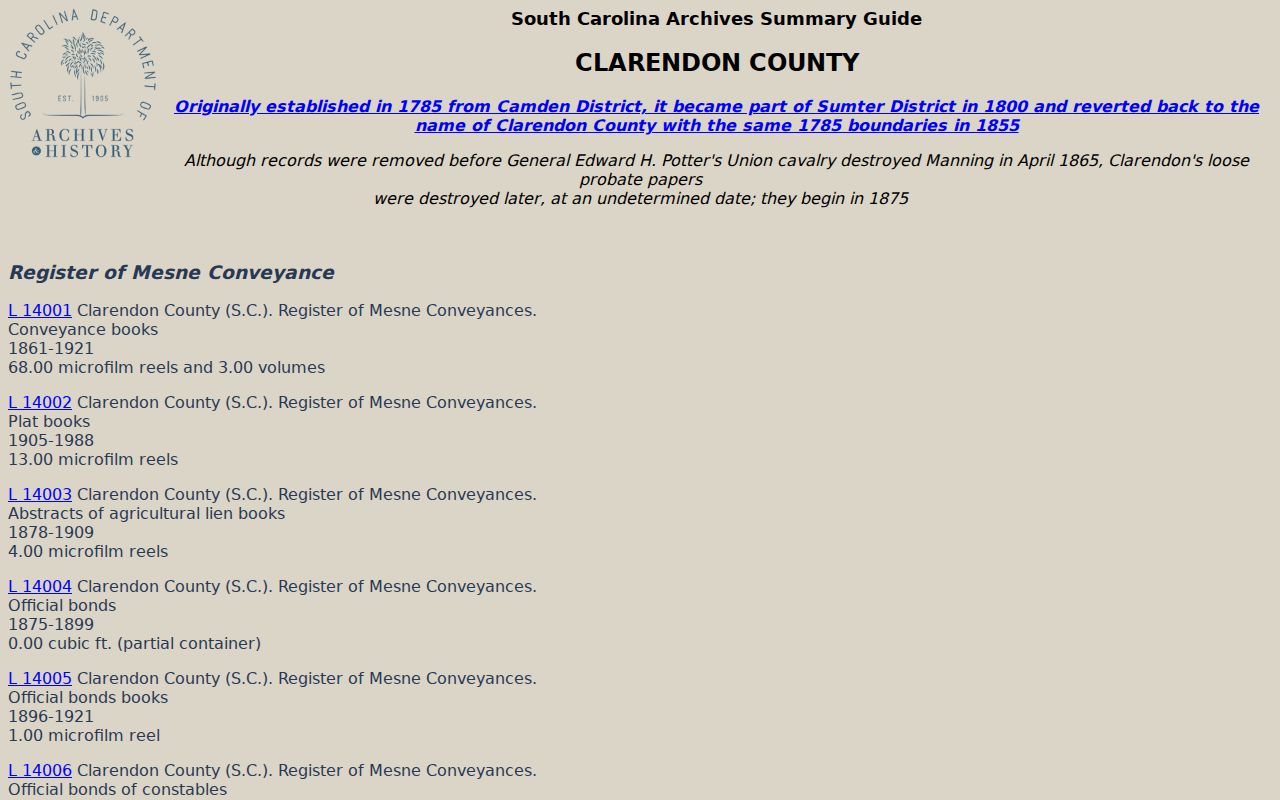
The image points to a different custodian, not a second version of Public Index. Begin with the approximate year, court, party name, and record series. Ask the current clerk about a modern file, and use the archival guide for journals transferred into historical custody. Keeping those tracks separate prevents a fruitless online search for a record that was never digitized.
Access & Restrictions
South Carolina FOIA provides access to nonexempt public records, but court access also reflects judicial rules, sealing orders, and laws that protect specific information. Sections 30-4-30 and 30-4-40 govern public-record access, response rules, fees, and exemptions. A Clarendon County criminal case view may omit juvenile material, protected victim or minor information, Social Security numbers, sealed content, or information restricted by another law.
The official South Carolina courts and legal-services directory supplied this broader court-system image.
The image places Clarendon County within the state system while leaving custody with the proper local court. An online omission can reflect a municipal coverage gap, a sealed or restricted case, a delayed entry, or a document that is only available from the clerk. It does not prove that no case exists. Confirm the venue, then ask that venue for the specific docket item.
Note: Confirm current copy charges before sending payment because no official Clarendon County criminal court fee sheet was found.